
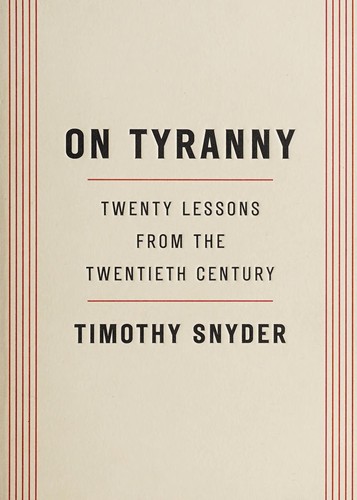
On Tyranny
2017
Snyder is a historian of the Holocaust, Nazi Germany, and the Soviet Union. In this 126-page book from early 2017, he argues that Americans are no wiser than the Europeans who watched democracy give way to fascism, Nazism, and communism, and that our one advantage is the chance to learn from what happened to them. His premise is that history does not repeat, but it does instruct. From that he builds twenty short chapters, each a single instruction for ordinary citizens. The lessons, in the book’s order:
- Do not obey in advance
- Defend institutions
- Beware the one-party state
- Take responsibility for the face of the world
- Remember professional ethics
- Be wary of paramilitaries
- Be reflective if you must be armed
- Stand out
- Be kind to our language
- Believe in truth
- Investigate
- Make eye contact and small talk
- Practice corporeal politics
- Establish a private life
- Contribute to good causes
- Learn from peers in other countries
- Listen for dangerous words
- Be calm when the unthinkable arrives
- Be a patriot
- Be as courageous as you can
Each chapter pairs its instruction with a historical example. The first sets the tone with what Snyder calls anticipatory obedience: citizens adapt to a new regime before anyone has ordered them to, and in doing so show the people in power what they can get away with. His example is Austria in 1938, where people who had never been Nazis started signaling loyalty on their own. The early chapters focus on what individuals and institutions do, and later ones turn to language, truth, personal habits, and the pull of nationalism. Snyder writes in short, direct sentences, so the book reads fast. I picked it up nine years after publication, and it holds up.
I’m a librarian, so the chapters on defending institutions and remembering professional ethics hit closest to home. Snyder argues that a rule-of-law state is hard to subvert without lawyers, and that show trials need judges. In his telling, the Nazi regime would have struggled to carry out its atrocities if the professionals it relied on had refused to take part, and professional ethics matter most when someone insists the situation is exceptional. My profession’s code of ethics commits us to intellectual freedom, to resisting censorship, and to protecting patron privacy. Those commitments mean something only when the people working inside the institution keep honoring them under pressure.
Recent events have made those chapters feel less abstract. In March 2025, an executive order directed the elimination of the Institute of Museum and Library Services, the only federal agency dedicated to libraries and museums, to the maximum extent allowed by law. Two months later, Librarian of Congress Carla Hayden was fired, and the White House tied the decision to her diversity efforts. The American Library Association and a public-sector union sued over the order, 21 state attorneys general filed a separate suit, and in November 2025 a federal judge in the states’ case ruled the attempt to shut the agency down illegal and unconstitutional. The administration appealed in January 2026. Separately, the ALA counted 4,235 titles challenged in 2025, its second-highest total on record, with 92 percent of challenges coming from pressure groups and government officials and fewer than 3 percent from individual parents. Snyder’s second lesson says institutions need defenders from the start. In the IMLS case, the ALA and state attorneys general were among them.
It’s a short, clear book, but a heavy one, and several passages made me stop and collect myself. Lesson 3’s advice to vote in local and state elections while you still can was one such gut-punch. All in all, it’s a sobering read, and I’m glad I read it.
Webmentions
This site supports webmentions via the IndieWeb and webmention.io. Mentioned this from your site? Let me know!